Martin Luther King Jr. and the Moral Weight of Time
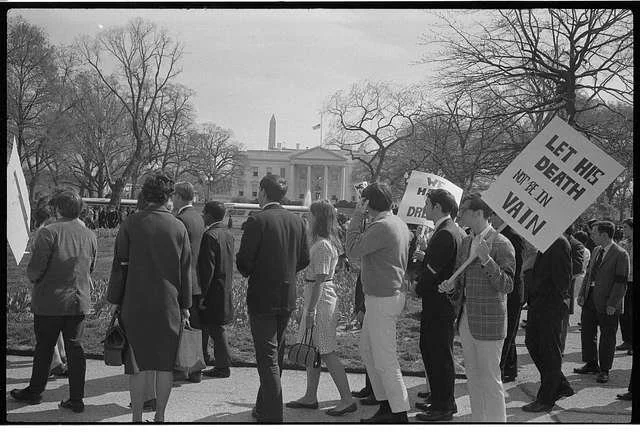
Demonstrators with signs, one reading "Let his death not be in vain", in front of the White House, after the assassination of Martin Luther King, April, 1968
Martin Luther King Jr.’s public philosophy treats time as a moral force, one that can either be activated by human agency or misused as a tool of delay, while also condemning neutrality. Across his many prolific speeches and personal writings, King repeatedly rejects the idea of “gradualism.” Instead, he argues for an ethical urgency that is grounded in the lived realities of injustice.
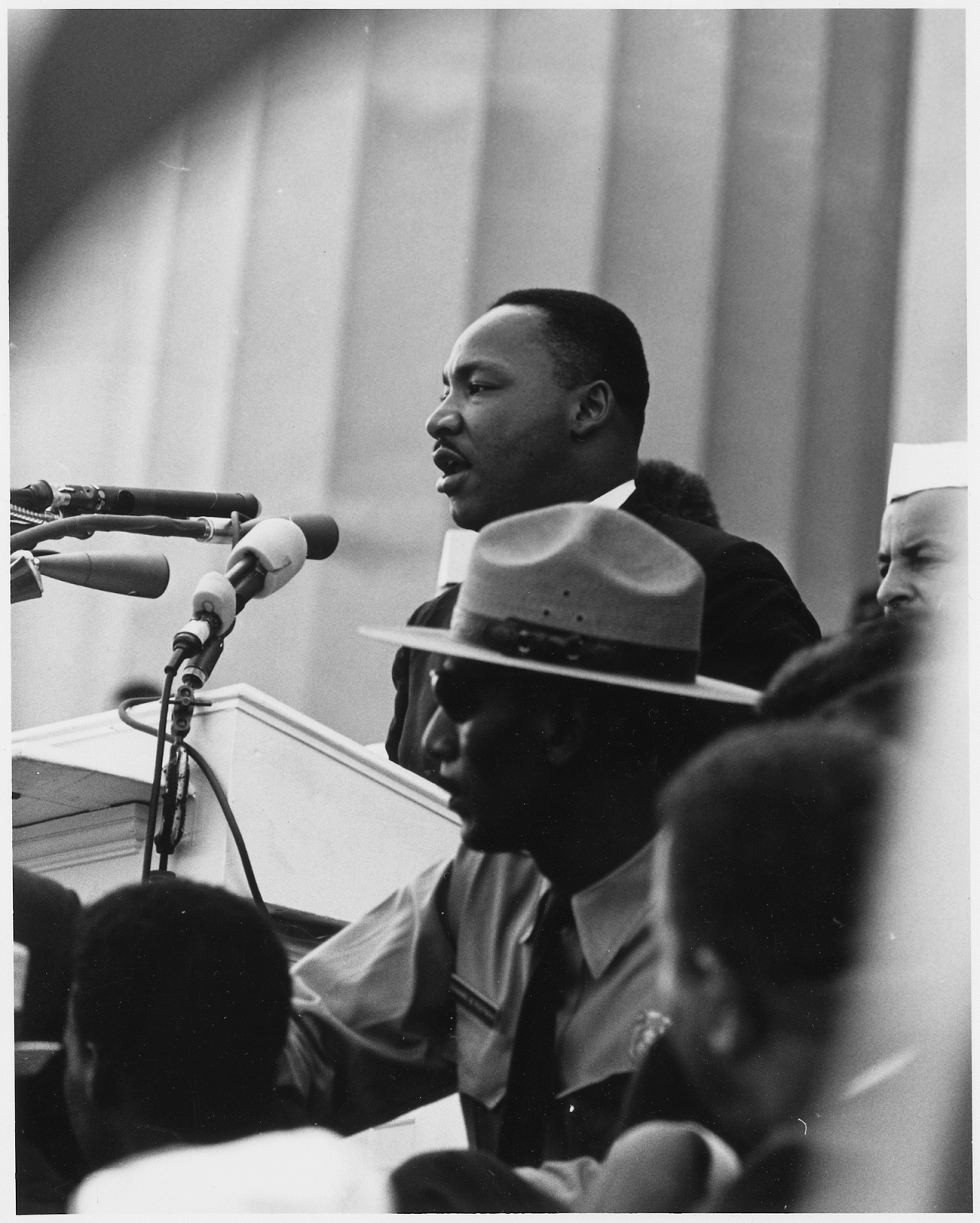
Dr. Martin Luther King, Jr. delivering his I Have a Dream Speech at the Civil Rights March on Washington, D.C. 08/28/1963
This position is articulated in King’s address at the March on Washington in August 1963, where he warned that “this is no time to engage in the luxury of cooling off or to take the tranquilizing drug of gradualism.”¹ In this context, time itself occupies a contested space. In delaying action while in the face of injustice, one is not being cautious; rather, in this moment, one has achieved a moral failure. They may claim it as steadfast, or even patience, but it is still inaction.
King continues his argument in Letter from Birmingham Jail (1963), where he confronts the demand that civil rights advocates “wait” for a more convenient moment. “For years now I have heard the word ‘Wait!’” King writes, knowing that waiting “almost always means ‘Never.’”² King understands better than most that time can equal power, as those unaffected by life’s injustices might delay as a means of preserving the status quo, while those who suffer the daily consequences of those injustices experience delay as a continuation of the harm they’re already enduring.
Even King’s often misquoted assurance that “the arc of the moral universe is long, but it bends toward justice”³ is misunderstood on many occasions as an argument for inevitability. In its full context, this quote is not a passive claim about destiny. It’s conditional. Justice, for King, is not guaranteed through the passage of time; it is realized through moral action and whether or not we as a people can sustain those moral actions. Without societal intervention, there is no justice.
These writings reveal a consistent philosophical stance: time acquires moral significance only through the choices we make as individuals in a society. When struck with injustice, the worst possible response is inaction. King’s insistence on the immediacy of action challenges anyone who might believe in waiting as a virtue.
If you want to honor the legacy of Dr. Martin Luther King Jr., you have to recognize the importance of using the time we have and the ethical demand to combat injustice. Each moment, in King’s view, poses us with a question of our own responsibility to our society and to one another. The passage of time alone does nothing without us. What matters is what is done now.
Dedication
This essay is written in memory of Renee Nicole Good, a poet, a writer, and a mother of three, whose life was taken by U.S. Immigration and Customs Enforcement (ICE) during a federal immigration enforcement operation in Minneapolis on January 7, 2026. Her death should stand as a reminder that injustice is not something that happens in the abstract, or a historical problem to be waited on, but a pressing reality that we must act on now, together.
I encourage every moral person to refuse to be neutral in times that call for action. I ask you to place yourself between those in need and an oppressive machine that would have you think “everything is ok”. As Martin Luther King Jr. insisted, time alone does not deliver justice. It is shaped by those willing to act within it.
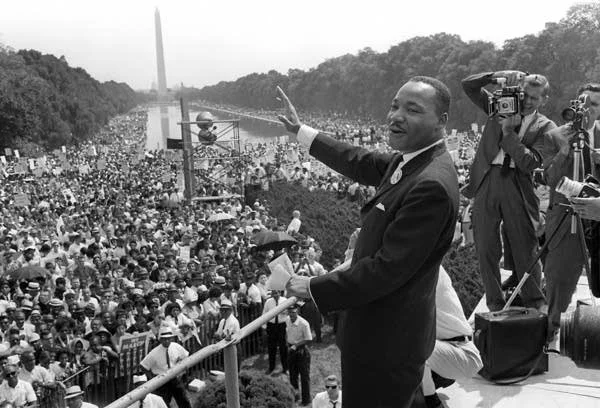
Martin Luther King Jr. waved to supporters from the steps of the Lincoln Memorial on Aug. 28, 1963, during the March on Washington.
AFP | Getty Images 1963
Citations
King, Martin Luther King Jr. “I Have a Dream.” Address delivered at the March on Washington for Jobs and Freedom, Washington, D.C., August 28, 1963.
King, Martin Luther King Jr. “Letter from Birmingham Jail.” April 16, 1963.
King, Martin Luther King Jr. Theodore Parker quote popularized in multiple sermons and speeches, including “Our God Is Marching On!” (Montgomery, Alabama, March 25, 1965).

REMEMBER, nerds…. to keep the comments clean. Please don’t make me pull out ole Abraham-Louis here.